

Just for fun
- Article 7 of 77
- Information Age, May 2001
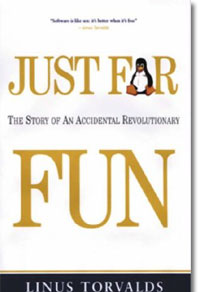
There are very few biographies that have actually changed the lives of their authors but Just for Fun: the Story of an Accidental Revolutionary claims to have done just that.
In fairness, however, Linus Torvalds, originator of the Linux operating system and subject of the book, does not appear to have had much of a life to start with...
Written over the course of a year in conjunction with Silicon Valley journalist David Diamond, Just for Fun is as much about Linux as Torvalds himself. The trouble is, as Torvalds confesses, his real-world skills are a little lacking. Just remembering a birthday or anniversary, important personal events and even his childhood is next to impossible for a man who has become a role model for thousands of programmers. Try asking him about the instruction sets of an Intel 80x86 processor, however, and he could fill another biography-sized book with ease.
So instead of biographical details and discussions about, say, Torvalds' children or how he feels about being married to a Finnish karate champion (Diamond talks more about Torvalds' family than he does), we have a fly-on-the-wall sketch of how the biography came into being, what happened while Diamond and Torvalds were writing it, and how the whole process affected them. The book also covers Torvalds' thoughts on kernel and operating system design, open source software, being a famous programming guru, and the meaning of life. There's even a potted history of Finland.
Where the book does excel is in its insight into the mind of a dedicated computer geek. In 1991, Torvalds spent almost a year in a darkened bedroom creating the core of what became - completely by accident and, to a certain degree, lethargy - Linux. During that time, Torvalds assures us, girls, social life, hobbies and family all took a place on the back burner while he concentrated on the far more pressing concern of producing a POSIX-compliant, Intel-based replacement for his existing operating system, because it did not do all he wanted it to. Gradually, through the help of Internet distribution, Linux gained momentum: fellow hackers started modifying it to suit their needs, feeding many of those enhancements directly into the source code itself.
One notable abridgement is Torvalds' flame war with Andrew Tannenbaum, the man who invented the MINIX operating system that Torvalds decided to replace and one of his childhood heroes (strangely, the book only includes the opening two salvos in the fight). While Tannenbaum makes some interesting points that are still applicable to Linux today, the general 'Linux is great' theme that permeates the book would have been more palatable if a touch of counter-argument had been allowed to invade the proceedings. Without this, Torvalds' arguments in favour of open source and against intellectual property come across as woefully naïve, as does the book's self-congratulatory tone over the stock market flotations of some of the Linux vendors whose valuations have nosedived since the book was written.
The writing process seems to have changed Torvalds for the better, though. It is clear that Diamond has forced him into bars and saunas in order to tease out the 'real' Torvalds. The ploy appears to have been successful: with a non-techie to talk to, Torvalds manages to start remembering parts of his childhood; miraculously, he also becomes interested in socialising, and even investigates the gym.
Just for Fun provides some insight into the mind of an accidental hero, but it seem to end too soon. At the close, the reader is left wondering: what happens now that Torvalds, aged 31, is growing up?