

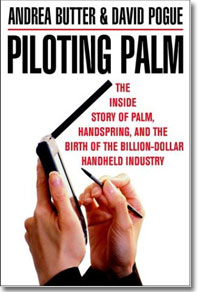
Piloting Palm
- Article 38 of 77
- Information Age, May 2002
The 'corporate history as thriller' genre has become firmly established in business publishing. Piloting Palm is a formulaic addition to the canon that only leaves the reader wondering why it was written.
The 'corporate history as thriller' genre has become firmly established in business publishing, with bodice-ripping accounts of how Oracle, Apple, Microsoft, IBM, et al rose to prominence. Piloting Palm, a potted history of handheld computer favourite Palm Inc and its spin-off Handspring, is a formulaic addition to that genre and one that leaves the reader wondering if it was worth the effort.
Although entertainingly recounted by New York Times columnist David Pogue and Andrea Butter, a former marketing executive for Palm, the histories of Palm and Handspring are in reality too short to justify such a lengthy tome: Neither company has peaked or died, and Handspring, founded in part on a belief that the next step in handheld computing would be the smart mobile phone, only fulfilled its raison d'être three months ago – after the book's conclusion was written.
Most interesting of all are the initial chapters detailing how the concept of a handheld, electronic organiser that could synchronise its contents with PC desktop applications evolved in the mind of Jeff Hawkins, a programmer with GRiD Systems in San Francisco. But that is where the interest level begins to wane. Palm is no Apple or Microsoft – it is hard to root for the company as an underdog that triumphs over adversity since, fairly early on, it gets taken over by goliath US Robotics and then 3Com. When Palm's founders leave to form competitor Handspring, it is hard to decide whether to start booing Palm or not.
What becomes clear, though, is how badly Palm dropped the ball – thanks to a succession of owners who did not know what to do with their new acquisition – and how lucky it was that its competitors were even more clueless. In the time between Palm's founding and the end of the book, Apple launched the Newton, which could easily have dominated the market but collapsed under a weight of hype and a failed handwriting recognition system; Sharp, Casio and other developers just gave up, unable to see what the market really needed; and Microsoft managed to develop seven different operating systems for handhelds and still not have a potential 'Palm killer' until Pocket PC 2002 – which, to this day, has little market share, despite claims to the contrary.
At times, the story comes across like a Keystone Cops movie: Hawkins accidentally and unknowingly disables a projector during the most vital demo imaginable by knocking the off switch; the first Pilot shipment is delayed because a sticker in the battery compartment is causing it to malfunction; a passport expires the day before a vital overseas meeting; Palm's entire corporate strategy u-turns within days of being set; and a core executive leaves to start his own business, marketing his own recipe for chocolate fudge sauce. Dubinsky even hands in Hawkins' notice at 3Com for him – without telling him.
The hint of insider knowledge that Butter's name brings to the book is isolated to anecdotes about corporate culture and her 'cash dance' through the office when large orders materialised. Almost everything else is culled from quotes in the press and interviews with a few of the key players. Neither Jeff Hawkins nor Donna Dubinsky, CEO of Palm and then Handspring, is portrayed as having the drive to succeed. Hawkins comes across through the thin characterisation as more interested in brain research than developing products, and Dubinsky spends most of her time fighting the CEOs of US Robotics and 3Com, instead of running Palm.
Although an enjoyable read, Piloting Palm offers no conclusion about its subjects. There is probably a good book about the rise of the handheld computer waiting to be written – but not for a few years yet.