

Tapping into the grid
- Article 20 of 77
- Information Age, October 2001
The majority of computers are idle most of the time. So how can companies tap into that wasted resource?
It was as long ago as 1985 that researcher Miron Livny showed that most computers are not the constant powerhouses people had once imagined them to be. Most of the time, in fact, computers are not doing anything at all. So, seeing an opportunity to put those idle moments to good use, Livny devised a system known as Condor, a way for over-worked computers to delegate their work to their under-used counterparts.
Since Condor, the ability to unite computers for a single project has evolved into established concepts such as clustering, parallel computing, render farms, load-balancing, and distributed computing. Now, in 2001, a new vision has emerged — 'grid computing'. The idea is that, just as no-one wonders which power station provides the electricity that powers a computer, computers linked together over the Internet into grids will provide all the resources – be they storage, databases, processing power or applications – that anyone needs, whenever they need it.
Ian Foster, co-leader of the Globus Project, an open source development designed to provide the necessary middleware for grid computing, is a Miron Livny for today. Indeed, Globus is used by most of the small grids in operation. “There are over 400 million PCs around the world,” estimates Foster, “many as powerful as an early 1990s supercomputer. Every large institution has hundreds or thousands of such systems.” There are already both corporate and academic grids on the web.
Multinational companies such as Pfizer, Ericsson, Hitachi, BMW, Glaxo and Unilever all have internal grids. Similarly, IBM links up its research laboratories around the world using a grid, and Intel believes its own internal grid has saved it $500 million over the past ten years.
SETI@home, a US-based scheme for searching radio-telescope data for signals from extra-terrestrial intelligence, now runs on half-a-million donor PCs over the Internet and delivers 1,000 CPU years per day (one CPU year being the amount of work one CPU performs in a year), making it the fastest computer in the world.
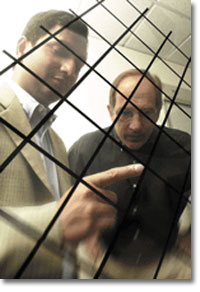
“We expect the technology to find its way rapidly into more conventional commercial development,” says Dave Turek, IBM's vice president of Linux and emerging technologies (pictured). Globus's toolkit allows developers to integrate grid capabilities into existing software relatively painlessly. Microsoft, for example, has contributed $1 million to Globus for research into adding grid tools to its Windows operating system as well as its proposed architecture for web services, .NET.
Some of the underlying business models of the companies that have pioneered grid computing leave a lot to be desired, however. One commercial grid service, Popular Power, has already bankrupted itself and others are fighting for resources against philanthropic grid projects such as SETI@home. Companies such as Entopia and United Devices (UD) pay users to download programs and give over their computers' idle time to commercial projects that require huge amounts of processing time, such as genetics research. UD also has an intranet version of the software so that companies can make idle PCs work to their full potential, according to CTO David Anderson.
Karen Benson, an analyst at the Gartner Group, says that the technology will appeal to businesses facing increasing pressure to maximise their return on IT investments. “Businesses could easily increase or decrease their use of computing power to meet the business needs of the moment. However, the price of the products and services that will eventually be offered will have to provide cost savings over conventional outsourcing.”
Globus's Foster argues that grid computing will come into its own when people learn to build “virtual organisations”, perhaps a manufacturing consortium developing a product. That will allow the consortium to runs simulations of components while keeping the proprietary information associated with members' components to themselves.
Bob Aiken, a manager at Cisco, argues that the biggest challenge to the deployment of grid computing will be developing a brokering system for paying for resources used on it. But before that, Globus, Microsoft and other grid developers still have some technological problems to solve; and, of equal importance, they must convince large corporations that they should hand over their data to anonymous PCs spread around the world.