

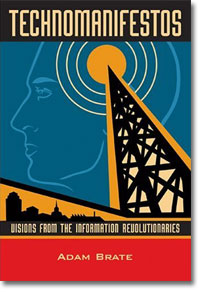
Technomanifestos
- Article 43 of 77
- Information Age, July 2002
Adam Brate's collection of short biographies is ultimately pointless.
It is hard to know exactly what Technomanifestos is all about. Is its subject the 'visionaries ' who developed the theoretical groundwork for modern computing? Is it about the technologists who are setting the political agenda for open source software and the Internet? Is it about people who created technologies such as the mouse? Or is it just a set of biographies of people the author, Adam Brate, has deemed important in the history of IT?
Freelance science journalist Brate, whose previous books include Making the Cisco Connection, argues that all of the individuals profiled stand apart for having penned 'technomanifestos' - treatises that set the foundation for modern computing. But his priorities are odd.
Alan Turing, arguably the inventor of mathematical computing, only gets to share a chapter with John von Neumann, the architect of digital computing. Indeed, most of the passages on Turing focus on his time at Princeton, where he did the least amount of breakthrough work. Sun Microsystems' techno-guru Bill Joy gets the same treatment. And Claude Shannon, who developed information theory, has his life's achievements spread thinly across the first section of the book.
Contrast that with the fact that, Vannevar Bush, the post-war US government adviser who, as Brate admits, was almost completely pre-empted by information management pioneer Paul Otlet, gets profiled in depth. And bizarrely, Richard Stallman and Eric Raymond, leading lights of open source, get to head separate chapters on the open source movement, thus padding out the book with much repetition.
In short, Brate has really focused on a group of (mostly US) scientists, mathematicians, computer programmers and engineers who have influenced the development of computing with inventions such as the mouse, open source software and the web, and who have also written 'manifestos' around their subjects.
Although not as fearsomely cliched as its tagline (Visions from the Information Revolutionaries), Brate's writing style does not possess the lively froth readers have come to expect of pop science and business books. Indeed, in an attempt to fit in with that general style, several facts have been distorted, most notably in the discussion on the inventions made at Xerox Parc. But if Stephen Hawking's well-known suggestion is true, that every equation in a book halves its readership, then Brate's stodgy too-complicated-for-the-general-reader, too-simple-for-scientists approach has to be worth a dozen quadratic equations.
There is little by way of conclusion to flesh out the raw biographical details or the Tomorrow's World-explanation of ideas that would make this digest worth buying. Any one of the subjects in this book deserves his own biography, but in nearly all cases Brate fails to show that these visionaries were anything more than influential.