


An open agenda
- Article 12 of 16
- LinuxUser & Developer, April 2006
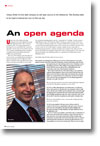
Unisys thinks it's the ideal company to sell open source to the enterprise. Rob Buckley talks to its head of enterprise Linux to find out why
Page 1 | Page 2 | Page 3 | Page 4 | All 4 Pages
Unisys is one of the oldest technology companies in the world – dating from an age when keyboards had no connections. Founded in 1873, the company began life as E. Remington & Sons and sold the first commercial typewriter. Over the years, it has evolved to become an IT company, manufacturing servers, providing consultancy services and offering outsourcing facilities among other things.
Like much of the industry, it uses Intel chips in its servers but has concentrated almost exclusively on high-end enterprise work. Yet unlike those other giants of enterprise technology, IBM and HP, Unisys is new to the open source party. For much of the 90s, its preferred operating system was Unix – in particular SCO UnixWare – but this century, it added Windows Server 2003 Datacenter Edition to its line-up and at the end of 2004, Linux.
We caught up with Hans Sparkes, the company’s EMEA head of enterprise Linux, to find out why Unisys has finally embraced open source and why it now thinks it’s the best choice of server vendor for the world’s largest companies.
LU&D: Why did Unisys make the move to Linux?
HS: Our strategy from 2000 was to move from closed systems to more open system on Intel. At the time, Microsoft’s Datacenter was the only product up for the job, but engineering were also looking at other areas. Internally, we were developing on Linux in 2003, adding 32-way support into the 2.4 kernel. All of the work we did we then contributed back to the community to give Linux that enterprise robustness.
But it wasn’t made known to the wider Unisys or our customers: engineers being engineers, they do lots of good stuff and they only tell you at the end when it’s just ready to be released. But, someone higher up recognised that in the market there was this trend called Linux, and saw what was happening. The two things happened to coincide, so we said, “Let’s do it”.
Linux has been around for some time and the first big rush happened in the late 90s. Why did you only latch on to it in 2004?
Prior to 2004, although there was activity there, it would have taken a brave person to say that Linux was enterprise ready. It really wasn’t. But the end of 2004 was the watershed: Linux moved through the tipping point. People like SAP and Oracle started delivering their Linux strategy and because major ISVs came in and said, “Look, we do this as well,” it was then recognised as a safe option to deploy Linux.
Are you only interested in Linux or are you also working with other open source products?
We’ve put together a full open source software stack for customers. We can go to organisations with open source choices at each level, from the platform through the high-availability side through networking through database through middleware up to the application end.
But we’ve tried to put together a stack that is also a combination of open source and closed source products so that customers have an easy route into a more open environment. If they’ve made major investment in products like Oracle and it still makes sense to continue with that then they should do so, but they should at least do it on a Linux platform in a more open environment. Then we can see which areas of open source make more sense in the future.
So we can put together a hybrid stack for them then certify the whole stack and give them level 1, level 2 and level 3 support. It increases the confidence of customers so they can make that first step into open source. They can retain the things they’re used to, but just put it on a Linux platform and use it as an opportunity to evaluate other open source areas around it.
Are you continuing to contribute to open source projects?
We’ve worked with a number of the ISV packages including MySQL and PostgresQL and we’ve put them in through the engineering side to help them remove any bottlenecks in their code. We’re active with the Xen group for virtualisation, we’re a member of the JBoss Consortium. We basically offer free advice, guidance and engineering effort to grow the whole market. That shows the maturity of our company that we’ve made that change away from developing stuff for ourselves.
We’re also trying to understand what we can do for our customers as well, to help them to put together services and to get competitive advantage for commercial organisations.
What do you hope to get out of your work?
As well as something to offer customers, it shows we can contribute. We recognise that open source is a whole new way of doing things. It’s all about service rather than licence fees. It’s all about sharing and being open and that’s something that we’re stepping up to as an organisation.
It’s also something we feel we can help clients with. We’ve had experience already. We know how to make this stuff work, we believe we can pass on some of that skill and best practices to our clients. We can help them with the discussion, the decision about how to move forward and what their future should look like.
What was the initial reaction of your customers to your move to open source?
Some were surprised. Obviously, we now have an extra component we can deliver. Many are now grateful there’s someone they can go to for advice because it is a confusing area. You don’t always know you’re getting the best advice, especially where suppliers have an alternative.
Because it’s such a new area, it has a lot of hype around how good it is and how everyone should be doing it. The customers say, “Yes, but what should I be doing?” We’re trying to driving a line through that, trying to derive the best route for each and every organisation, because they’re all at different rates of adoption: some may have started, some may not. It’s useful to have someone impartial, because we don’t have a proprietary system to propose as a primary offer. We can say it does depend and we’ll help you work on the decision process. That’s refreshing to some people. They would trust us because of our enterprise background. We care about the final solution.
Has the move to open source attracted any new customers?
We have had some success in terms of attracting new business. We find that almost every organisation has got Unix somewhere and they want to know if they should now be looking at Linux.
The other area it helps with is application development. There’s a whole area here that organisations haven’t necessarily got their heads around which is how to integrate some of the open source libraries and components into their own development suites. There’s a whole new boundary yet to be explored.
So we'll be looking at every one of our customers and saying, “Where should you be on this journey? What’s the right approach for you to take? Does it make sense and how does it help you take that first step?”
Organisations need to evaluate what they should be doing. They can’t avoid it. They may have strong views for or against but they can’t avoid the decision. Some people actually use the decision as a chance to stop and rethink what they should be doing for the next few years. They can forget history and ask what they should be doing.
What can we expect to see from Unisys in the next couple of years in terms of open source development and promotion?
There’s going to be more management in there, more virtualisation, more on the dynamic partitioning. Linux will almost be on a parity with Unix in most people’s eyes. In two years, there’ll be almost nothing between them and then it’ll be much easier to decide what to do in the future: it’ll be Linux, no debate. At the moment, there’s still some hesitancy from organisations that have their core applications deployed on Unix. Unless they’re coming to a major change, do they want to make that step? We can demonstrate it’s worth doing it, but once we get parity in terms of functionality, it’ll be a much easier decision.
Why should a company come to you for their open source needs, rather than IBM or HP, say?
The objective bit. With the best will in the world, if you’ve got competing offerings, you’re not going to be so objective as an organisation that you’ll say, “We do this on open source,” and that’s it. We have an edge there.
From the engineering side, our engineering depth and breadth of contributions to open source and Linux over the years will put us in good stead. We’re able to deliver that as a service to customers because we’re prepared to put engineering resource in specific projects.
I guess the other area is the full certification. Although other organisations claim do some of it, no organisation puts its arms around the whole lot and says it’s doing all of it. Our efforts around certification support and revision management – of all of that will help customers to make that first step and take away that risk for them.
About Hans Sparkes
Hans Sparkes, Unisys’s head of enterprise Linux in Europe, the Middle East and Africa, has been responsible for developing and growing the company’s enterprise Linux business in the region since the launch of its global Linux strategy in August 2004. Prior to Unisys, Hans held several development and marketing positions in organisations including Data General, Mitsubishi and ICL. He joined Unisys in 1999.
Page 1 | Page 2 | Page 3 | Page 4 | All 4 Pages