
How to improve your brain with a Mac
- Article 80 of 89
- MacFormat, October 2009
Let your Mac help you to become even smarter
Page 1 | Page 2 | Page 3 | All 3 Pages
Your Mac’s clever. Very, very clever. It’s also very, very dumb. Let’s face it: without you, it would be nothing. It would just sit in the corner of a room, inactive. Your Mac may be your greatest asset, but you are also its.
Isn’t it great that you can help each other?
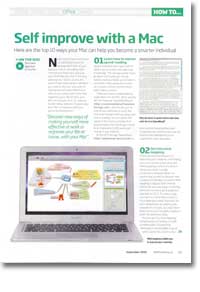
You see, not only can you make your Mac smarter, your Mac can make you smarter, too. It’s one of the best tools around for helping you learn about just about anything.
Learning how to learn better is one of the first things your Mac can help you with. After all, it’s much better to spend a few hours improving your learning skills than waste days trying to learn things with nothing going in.
There are many techniques for improving your learning skills. Mind Mapping is one of the best ways to organise your thoughts and learn: it allows your brain to make connections between ideas in a natural way, as well to discover new connections between concepts. You start with a central idea or word in the middle and create ‘branches’ from it for each related idea. By creating this network of concepts, you may find it helps you to clarify your thoughts and make it easier to remember ideas.
Fortunately, there are many different mind-mapping applications available for your Mac. Each has advantages and disadvantages, depending on the purpose you’re using it for. To get the most from mind mapping, you’ll have to find the application that suits you, but the best are MindJet MindManager (http://www.mindjet.com/products/overview.aspx); ConceptDraw Mindmap (http://www.conceptdraw.com/en/products/mindmap/main.php), iMindMap (http://www.imindmap.com/features/), NovaMind (http://www.novamind.com/), and OmniGraffle (http://www.omnigroup.com/applications/OmniGraffle/).
Speed-reading is also a good skill to have if you’re going to be digesting knowledge. The average reader reads at about 200 words per minute. Speed-reading lets you take in more than 1000 words per minute, but requires serious concentration, which takes practice.
There are various speed-reading tutors for the Mac. Most work like the freeware Speed Reading III (http://customsolutionsofmaryland.50megs.com/speedreadingiii.htm/), which lets you try to read by looking at two midpoints on each line and moving forward without going back and re-reading. You can adjust the speed of the moving window from approximately 200 words per minute to 1,500 words per minute as you get better.
A more sophisticated application is iSpeedRead (http://ispeedread.iverbum.com/), which includes comprehension tests to see if you’ve retained the information you’re supposed to have absorbed.
Simple sharpness of thinking is another great asset to have, in and of itself. If you just want to get your mind working at a faster pace, a little exercise will go a long way. Crosswords are a good way of getting your verbal skills warmed up. There are a significant number of crossword puzzle programs for the Mac, as well as a number of online puzzles at various newspapers’ web sites. Infinite Crosswords (http://www.macgamestore.com/detail.php?ProductID=760) gives you access to Sunday puzzles from the LA Times and the Washington Post; the New York Times has a subscription service and a dedicated cross-platform crossword puzzle program built using Adobe Air (http://www.nytimes.com/timesreader), and there are programs for mobile phones, including the iPhone, as well (http://www.magmic.com/nytimes/crosswords-get.php).
For those who want to enhance their numerical skills, Sudoku are a great way to get thinking in the right way. There are many Sudoku programs out there, including Web Sudoku Deluxe (http://www.websudoku.com/deluxe.php), SudokuAdept (http://www.hexcat.com/sudokuadept/index.html), which comes with millions of Sudoku, and Xudoku (http://stephen.dsm.geek.nz/xudoku.html), which lets you create as well as solve Sudoku.
Both crosswords and Sudoku are, in their own way, “brain trainers”. Brain training is now a widely understood concept, with Nintendo’s Wii and Dr Ryuta Kawashima’s Nintendo DS “Brain Training Academy” games among the most widely used programs for those. Brain training involves practising certain aspects of cognition, such as memorisation, spatial analysis, identification of objects, arithmetic and verbal reasoning. By practising, you can improve your skills in these areas.
The Mac doesn’t have a great selection of brain training programs, although it does have the open source iMemory (http://mac.softpedia.com/get/Games/iMemory.shtml) and Brain Workshop (http://brainworkshop.sourceforge.net/). But the iPhone, has an ever-increasing number, including MindDojo (http://dbelement.com/apps/minddojo), Brain Tuner (http://www.gengarstudios.com/) and Brain Exercise (http://www.morebrainexercise.com) from Dr Kawashima himself.
Armed with your new learning skills, you can now go out and fill your brain with knowledge. The best place to start is the good old encyclopaedia. All you need to access Wikipedia (http://en.wikipedia.org) is a web browser, although the Dictionary application in your Applications folder provides a nicer-looking way to view it. However, there are good things and bad things about Wikipedia: on the plus side of the equation, anyone can edit a Wikipedia entry; on the minus side, anyone can edit a Wikipedia entry. So you can find entries on an incredible variety of subjects in equally incredible depth, but also find really quite cursory entries on important subjects that can be filled with inaccuracies.
If you’re after absolute reliability and depth of knowledge, the Encyclopaedia Britannica (http://www.britannica.com/) should be your first call. You can either use this through your web browser (for a fee) or buy one of the many DVD editions available from the site. Unlike the old print version, which would set you back a few hundred quid as well as need most of the wall of a room, the DVD version is only £39.99 and has multimedia content as well.
But learning isn’t just about having access to information and reading it: it’s about remembering. Many educational resources on the Mac also come with facilities for testing what you’ve learned. Unsurprisingly, some of the best of these teaching tools are designed for people going to school and revising for exams. Both Encyclopaedia Britannia and Letts produce excellent tools (http://www.bluemooneducation.co.uk/acatalog/GCSEedu.html) for teaching, revising and motivating you to learn a range of GCSE subjects, from the sciences to English to Geography and History. For the advanced student, there’s Doris Kindersley’s (http://www.startupmedia.co.uk/PC%20Software/Education%20and%20Reference/) A-level teaching and revision software. At both GCSE and A-level, the programs are more of a supplement to learning than an entire course, so don’t think you’ll be able to pass an exam using just the software. But you’ll certainly end up knowing more by the time you’ve finished using them.
Learning an instrument has its own challenges, but the Mac’s there to help – provided you own an instrument, of course. GarageBand 09, part of iLife, comes with ‘Basic Lessons’, which teaches you the basics of finger placement and chords for piano and guitar. For those who already know the basics, GarageBand’s add-on ‘Artist Lessons’ (£3.95 each, available within GarageBand) gets the likes of Sting, Norah Jones and Sarah McLachlan to take you through their songs and techniques.
Good alternatives which eventually go further than GarageBand are iPlayMusic (http://www.iplaymusic.com), which provides many resources, including a Mac program with videos and 26 songs to play along with. eMedia’s Piano and Keyboard Method (http://www.emediamusic.com/pkm.html) has 300 step-by-step lessons for learning the piano, while Practica Musica (http://www.ars-nova.com/aboutpm5/index.html) teaches the fundamentals of music theory and ear training.
Languages are the main area of adult-learning, however, and these have their own particular requirements. As well as grammar and potentially a new alphabet to learn, there’s inevitably the rote learning required to get the thousands of new words you’ll need crammed into your memory.
Flashcards have, since time immemorial, been the number one way to learn vocabulary, and the advent of new media has allowed them to become more than simple double-sided bits of paper: now they can include sound files so you know how words are supposed to be pronounced. If you want to fashion your own flashcards, iFlash (http://loopware.com/iflash/) is far and away the best flashcard software: not only can you create multimedia flashcards for learning at home, you can print them out to learn on the go or you can synchronise your card decks with the free iPhone application.
If you don’t want to create your own flashcards, Byki’s Express and Deluxe software (http://www.byki.com/) covers over 70 languages, and includes MP3s and a pronunciation tutor that analyses what you say and corrects it. There are also iPhone apps of the flashcards for the most popular languages.
For those who want more complete language learning courses, Rosetta Stone (http://www.rosettastone.com) is one of the most popular tools available – although it’s also phenomenally expensive ($499 for a complete set of levels one to three). It throws away flashcards in favour of a more immersive approach, flooding you with words, images and the voices of native speakers, just as you learnt to speak English when you were a child. Many people will find EuroTalk’s TalkNow software (http://eurotalk.com/en/) a far cheaper and more friendly alternative, since includes quizzes, memory games, a printable dictionary and MP3s to listen to. But at the top of the list is Berlitz’s Premier language software (http://www.avanquest.com/UK/education/language-learning/index.html?page=2&sort=&sort=1), which includes all the features of other software, as well as role-playing, video of native speakers so you get to see their body language and gestures, and interactive transcripts of long scenes. There’s no proper grammar trainer and it’s only available for a few languages, but at £29.35, that’s just quibbling.
You have the potential inside you to become more than what you are. Your Mac can help you unlock that potential, if you know where to look.
Page 1 | Page 2 | Page 3 | All 3 Pages