

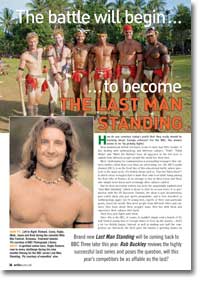
The battle will begin to become the Last Man Standing
- Article 1 of 5
- Action Network, October 2008
Brand new Last Man Standing will be coming back to BBC Three later this year. Rob Buckley reviews the highly successful last series and poses the question, will this year’s competitors be as affable as the last?
Page 1 | Page 2 | All 2 Pages
How do you convince today’s youth that they really should be learning about foreign cultures? For the BBC, the answer seems to be ‘by picking fights’.
Now mainstream British television seems to have had little trouble of late dealing with anthropology and different cultures. “Tribe”, “Tribal Wives” and “Meet The Natives” have all appeared in the last year to explain how different people around the world live their lives.
More challenging for commissioners is persuading teenagers that cultures further afield than even Ibiza are interesting, too. The BBC’s youth channel, BBC3, is on the front line of this educational battle, where spectacle is the main tactic. It’s fielded shows such as “Can Fat Teens Hunt?”, in which obese teenagers had to hunt their own food while living among the Iban tribe of Borneo, in an attempt to lure in Xbox lovers and those who simply never knew such seemingly alien cultures existed.
But its most successful venture has been the surprisingly sophisticated “Last Man Standing”, which is about to start its second series. A co-production with the US Discovery Channel, the show is part documentary, part reality show and part sports programme, and is best described as ‘anthropology aggro’. Six fit young men, experts at their own particular sports, travel the world. They meet people from different tribes and cultures. They learn about these peoples’ ways. They live with them and experience their cultures first hand.
Then they pick fights with them.
Since this is the BBC, of course, it couldn’t simply send a bunch of fit, well trained young men to foreign climes to beat up the natives – that’s a bit too British Empire. Instead, as well as making sure half the competitors are American, the Beeb gives the natives a sporting chance by letting them pick the fight rules.
The sports chosen were: Zulu stick fighting, Mexican endurance running, Nagaland kickboxing, Mongolian wrestling, Tobriand cricket, Wolof wrestling and Sepik canoe racing. In the US, where the show aired as the more politically correct “Last One Standing”, the Westerners also went on to compete in Kraho log running, Andean ice racing, Javan martial arts and Vanuatu canoe racing in a further four episodes.
Many of these sports are variants of wrestling, differentiated from Western wrestling purely by rules; Tobriand cricket is a variant of cricket that mainly involves considerable singing and dancing, usually after and before every ball, while Sepik canoe racing requires the competitor to stand up to paddle their narrow canoe. Unlike their Western counterparts, the “home teams” have been competing at many of these sports since they were children and frequently the competitions with other tribes or villages have stood in as proxies for wars – honour and glory have usually been at stake for the competitors.
Rather than send experts in the Western counterparts to these events, the Beeb picked a weightlifter, a runner/mountaineer, a fitness guru, a kickboxer, a cricket/rugby player and a BMX racing champion. While there were some crossovers in which one team member might have had an advantage – the kickboxer with the kickboxing contest, the cricketer with the cricketing contest and the runner with the running contest, for example – injuries or freak accidents invariably prevented the favourite from winning. All the same, skill at one sport seems to be a relatively transferable skill, with the Western team doing very well at some of the events.
The first series of “Last Man Standing” was a surprisingly touching and endearing show. Anyone expecting a bunch of arrogant ‘jocks’ would have been sorely disappointed by the personable contestants. While the Americans had greater confidence than the more self-effacing Brits, everyone involved turned out to be pleasant and friendly. ‘Trash-talking’ was kept to a minimum and the competitors even celebrated each others birthdays and took time out to help those who had fallen behind.
Page 1 | Page 2 | All 2 Pages