

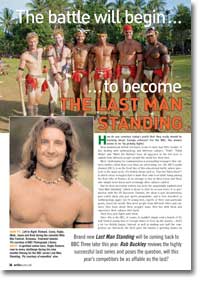
The battle will begin to become the Last Man Standing
- Article 1 of 5
- Action Network, October 2008
Brand new Last Man Standing will be coming back to BBC Three later this year. Rob Buckley reviews the highly successful last series and poses the question, will this year’s competitors be as affable as the last?
How do you convince today’s youth that they really should be learning about foreign cultures? For the BBC, the answer seems to be ‘by picking fights’.
Now mainstream British television seems to have had little trouble of late dealing with anthropology and different cultures. “Tribe”, “Tribal Wives” and “Meet The Natives” have all appeared in the last year to explain how different people around the world live their lives.
More challenging for commissioners is persuading teenagers that cultures further afield than even Ibiza are interesting, too. The BBC’s youth channel, BBC3, is on the front line of this educational battle, where spectacle is the main tactic. It’s fielded shows such as “Can Fat Teens Hunt?”, in which obese teenagers had to hunt their own food while living among the Iban tribe of Borneo, in an attempt to lure in Xbox lovers and those who simply never knew such seemingly alien cultures existed.
But its most successful venture has been the surprisingly sophisticated “Last Man Standing”, which is about to start its second series. A co-production with the US Discovery Channel, the show is part documentary, part reality show and part sports programme, and is best described as ‘anthropology aggro’. Six fit young men, experts at their own particular sports, travel the world. They meet people from different tribes and cultures. They learn about these peoples’ ways. They live with them and experience their cultures first hand.
Then they pick fights with them.
Since this is the BBC, of course, it couldn’t simply send a bunch of fit, well trained young men to foreign climes to beat up the natives – that’s a bit too British Empire. Instead, as well as making sure half the competitors are American, the Beeb gives the natives a sporting chance by letting them pick the fight rules.
The sports chosen were: Zulu stick fighting, Mexican endurance running, Nagaland kickboxing, Mongolian wrestling, Tobriand cricket, Wolof wrestling and Sepik canoe racing. In the US, where the show aired as the more politically correct “Last One Standing”, the Westerners also went on to compete in Kraho log running, Andean ice racing, Javan martial arts and Vanuatu canoe racing in a further four episodes.
Many of these sports are variants of wrestling, differentiated from Western wrestling purely by rules; Tobriand cricket is a variant of cricket that mainly involves considerable singing and dancing, usually after and before every ball, while Sepik canoe racing requires the competitor to stand up to paddle their narrow canoe. Unlike their Western counterparts, the “home teams” have been competing at many of these sports since they were children and frequently the competitions with other tribes or villages have stood in as proxies for wars – honour and glory have usually been at stake for the competitors.
Rather than send experts in the Western counterparts to these events, the Beeb picked a weightlifter, a runner/mountaineer, a fitness guru, a kickboxer, a cricket/rugby player and a BMX racing champion. While there were some crossovers in which one team member might have had an advantage – the kickboxer with the kickboxing contest, the cricketer with the cricketing contest and the runner with the running contest, for example – injuries or freak accidents invariably prevented the favourite from winning. All the same, skill at one sport seems to be a relatively transferable skill, with the Western team doing very well at some of the events.
The first series of “Last Man Standing” was a surprisingly touching and endearing show. Anyone expecting a bunch of arrogant ‘jocks’ would have been sorely disappointed by the personable contestants. While the Americans had greater confidence than the more self-effacing Brits, everyone involved turned out to be pleasant and friendly. ‘Trash-talking’ was kept to a minimum and the competitors even celebrated each others birthdays and took time out to help those who had fallen behind.
In part, this was because the idea that “Last Man Standing” was merely a sporting competition didn’t seem to occur to anyone, with everyone recognising it as a privilege and a chance to learn as much as possible about other cultures. The competitors were touched by the generosity of the people they stayed with: one of the Mexican villagers gave up his house and slept outside so that the contestants had somewhere to stay; and when another group of villagers learnt that Brad, the weight lifter, was missing his wife and children back home, they put on a party for him. The competitors were also surprisingly sensitive, with Jason, the BMX champion and tree surgeon, getting deeply upset by the tree burning and eco-system devastation practised by the Mongolians, for example.
Indeed, in the one vestigial British Raj element of the show, the competitors proved to be best at the after-contest activities. Jason is, naturally enough, great at chopping trees. Brad was then able to help carry the trees afterwards. And so on.
The competitors were also prepared to give languages a go, when they could, speaking Spanish to the Mexicans, French to the Senegalese and giving pidgin a brave attempt, too, when faced with Papua New Guinea tribesmen disconcertingly called Dominic and Paul. For some reason, a different contestant every week also felt the need to visit the local shaman and learn about the local magic. Producer input or natural curiosity? Whichever it was, the competitors seemed very willing to try all sorts of potentially dangerous hallucinogens and purgatives in the name of exploration.
To keep teenagers watching, we also had the tried and tested ‘gross factor’ added at as many points as possible. One episode involved what could tactfully be described as ‘canine masturbation’. Rajko, the fitness guru, nearly sliced off one of his toes while chopping wood for the Trobriand. And the most bizarre of the sports featured, Mexican endurance running, involves running a marathon round a village while kicking a wooden football and wearing a pair of shoes made from recycled tyres. Unsurprisingly, the foot injuries were spectacular – and were displayed to camera in all their glory.
Since the contestants needed to forage for their own food, there were ‘I’m a Celebrity…’ style bush-tucker grub-eatings, as well as far more harrowing practices: animal lovers would have been well advised to steer clear of the Mongolian episode, which involved cutting open a sheep, reaching inside it and severing one of its arteries to kill it, as well as the equally horrifying removal of lambs’ testicles while they were still conscious and squealing. By the end of the contest, most of the contestants were thinking about becoming vegetarians.
In a different kind of education for youth viewers, the contestants demonstrated true bravery and sportsmanship as well. In an ending that would have looked implausible in a movie, the nearly de-toed Rajko marched out onto the Trobriand cricket field against doctor’s orders to win the game for the villagers, who were playing for their honour against a nearby village and trailing badly. Richard, the cricketer and previous favourite who had been winning until that point, had to admit you “[couldn’t] argue with heroism”. One villager went on to name her child after Rajko, such was the esteem he’d brought to the village.
When the contest proved to be a dead heat, with three of the athletes having won two events each, they generously cast a ballot to decide among themselves who deserved the crown and unanimously declared Jason overall winner because of his attitude and self-development.
The popularity of the show(s) in both the US and the UK meant that a second series was commissioned relatively quickly and is due to air soon. This time, the competitors will be boxing fire-fighter Wole from London; submission wrestler and traffic cop JJ from Florida; Devon kite-surfer Murray; rugby player Jarvis from San Diego; modern pentathlete Ed from London; and soccer player Joey from Chicago. First stop will be Southern Ethiopia, where they will compete in Suri stick fighting, before they head off to Burkina Faso. Previews suggest that this year’s competitors will be as affable and as curious as the previous series’ – which can only be a good thing.