
Merger Mechanics
- Article 5 of 77
- Information Age, February 2001
Corporate mergers often hinge on the successful integration of two incompatible IT infrastructures. How can IT managers ensure a successful outcome?
Page 1 | Page 2 | Page 3 | All 3 Pages
Beveridge says that one of the first things that has to be done to make a merger successful is to deal carefully with the IT people in both organisations. “It depends a lot on the commitment of key people to make it happen. Any perception of winners and losers needs to be overcome. With every merger, there are people who will embrace it and see bigger opportunities in a bigger organisation. But others will see it as a threat to their own position. There may even be active resistance from people who are determined to make sure it won't be easy. They have to be taken out.”
It might not be possible to get everyone on the side of a merger though, says Josty, who advocates identifying a different group of key people. “In every company, there are programs and processes that are undocumented and only a few people who know how they work. You need to find out who these people are and do everything you can to keep them on board, locked them in even if it's only for the duration of the integration process.”
Prioritise or fail
On a wider scale, two different companies will have two different cultures and ways of doing things. “All sorts of agendas come out of the woodwork,” says Beveridge. “Company A may have a policy of trust in its staff to do what they like with their PCs. Company B might be centrally controlled and not allow such latitude. So you have 1,000 people used to working one way, and 1,000 people used to working another.”
So during the merger process, communication of new or changed practices is of the essence, says AstraZeneca's Burfitt. They need to be kept up-to-date on what's going on and why it's being done, particularly if there's a change in policy for one company. But first, Beveridge, Burfitt and Josty all agree, you need to be clear about the aim of the merger. Only then can you decide what degree of integration is necessary.
“When the merger [between Astra and Zeneca] was announced,” says Burfitt, “before any appointments were made in information systems, my senior colleagues and I sat down and worked through plans to decide what was needed to integrate systems globally so they contributed to the overall synergies of the merger. We drew up a list of all the major systems, and as part of a global organisation we had to consider very carefully what the requirements were.”
Drawing up plans, however, shouldn't be equivalent to prevarication. The plans should be general rather than detailed, or merging companies will end up in the same situation as that of the insurance companies that Josty advised, which took a year to decide what systems would be integrated.
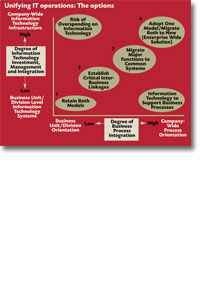
The plans should consist of three phases, says Beveridge. “In the short to medium term, co-existence will be necessary,” he explains, “with both companies having to operate independently.” Any attempts at full-blown integration won't pay off for months or years, so trying to do everything immediately will simply result in absolutely separate systems, and thus companies, in the short term, he says.
Accenture's Chang argues that during this period, the task of the IT department will be to “expedite integration and ensure stability”, two seemingly incompatible tasks. “Successfully expediting integration is largely a matter of recognising that 'good enough' is good enough.” Perfection isn't necessary because the challenge will be to cope with the sheer volume of integration or systems replacement work involved. Any discretionary work must be put to one side so that staff can concentrate on the highest priorities listed in the plan. And all that might be achievable in the short term is the building of gateways and interfaces between systems, rather than any standardisation or total integration.
In the third phase, systems can be integrated more fully, but the degree of unification is up to the companies concerned. Burfitt advocates integrating global systems such as the companies' intranets and enterprise resource planning (ERP) systems, but for local applications, no integration is necessary. It is also worth standardising on a common desktop across the enterprise.
While Josty can think of several situations in which integration beyond the basics is unnecessary and the two companies can continue running more or less separately, he has also seen companies decide that their existing software is not up to the challenges of the integration and that they need something completely new. “But that's a lot rarer.” One exception, Burfitt took the opportunity following the AstraZeneca merger to standardise on a corporate-wide ERP system from SAP.
Page 1 | Page 2 | Page 3 | All 3 Pages