
Merger Mechanics
- Article 5 of 77
- Information Age, February 2001
Corporate mergers often hinge on the successful integration of two incompatible IT infrastructures. How can IT managers ensure a successful outcome?
Page 1 | Page 2 | Page 3 | All 3 Pages
When large companies combine, the challenge of bringing together their IT infrastructures can often make or break the deal, and even determine the chances of the merger's success. In fact, there are plenty of anecdotes about chief executives hatching mega-mergers with scant regard for the underlying IT issues. And while most aspects of the merging of two entities can take a few quarters, the integration of their IT infrastructures often drags on for years, and sometimes even undermines the effectiveness of the new organisation.
So how do IT managers ensure their companies survive and prosper after a merger? And what advice can they offer a company that is about to acquire or merge with another?
Last to know
Despite the huge cost and the technical difficulties associated with mergers, the IT integration issues have traditionally been overlooked during a merger and still are. N Venkatraman, a consultant at Concours Group, which has studied how IT has been affected in companies involved in mergers and acquisitions, says: “There are more cases in which IT is not involved because there is no context in which it can be brought into the merger [negotiations]. To understand how IT is used to create business processes is to recognise IT as an important part of the framework. In other words, CIOs need to get involved as soon as possible, because the accounts and HR departments are always consulted but IT rarely is, even though IT is important to every part of the business.”
That view is echoed elsewhere. “The IT director's role has traditionally been underrated,” argues Paul Cartwright, financial services partner at Accenture.
“People focus on the financial and geographical elements of a merger, but it's only recently that financial institutions [that influence the outcome of a merger] have seen that the seeds of the successful merger are in operations and IT.”
However, that is changing. According to a survey by Arthur Andersen, 63% of companies now regard IT as a “very important factor” in a merger and see the merger as an opportunity to reduce IT costs through economies of scale.
Richard Chang, a partner in Accenture's Strategic IT Effectiveness practice, says organisations can expect on-going IT savings of 15% to 30% of costs following a merger, while Paul Burfitt, global CIO at AstraZeneca - the pharmaceutical giant formed in 1999 following the merger of Astra with the Zeneca Group - says that savings of between 10% and 30% are possible, depending on the merging companies' priorities.
Fall guy
That is where a lot of board-level eyes are trained, post-merger. Hugh Josty, a member of PA Consulting's management group, has consulted on four different mergers. “IT often gets cast as the fall guy,” he says. “They're the people who are under the 'critical' heading for achieving the budgets of merger. But the task that goes on longest is IT integration work. So 'Why is it taking us 18 months to close down old systems and get on a common infrastructure?' is a pretty common question.”
Sometimes, whole mergers can hinge on whether IT can achieve that integration process. Josty cites the example of an insurance company merger that was based on the assumption that the two companies' databases could be combined easily. The merger plans collapsed when it was discovered that they couldn't and that “even the definitions of the policies were different”.
Colin Beveridge, an 'interim' CIO who has been through several IT mergers, recalls an incident where he was called in too late to help the companies concerned. “By the time I was there, the situation had deteriorated too far. The merger disintegrated a few months after I left. But it took 18 months to get to that point.”
Beveridge says that one of the first things that has to be done to make a merger successful is to deal carefully with the IT people in both organisations. “It depends a lot on the commitment of key people to make it happen. Any perception of winners and losers needs to be overcome. With every merger, there are people who will embrace it and see bigger opportunities in a bigger organisation. But others will see it as a threat to their own position. There may even be active resistance from people who are determined to make sure it won't be easy. They have to be taken out.”
It might not be possible to get everyone on the side of a merger though, says Josty, who advocates identifying a different group of key people. “In every company, there are programs and processes that are undocumented and only a few people who know how they work. You need to find out who these people are and do everything you can to keep them on board, locked them in even if it's only for the duration of the integration process.”
Prioritise or fail
On a wider scale, two different companies will have two different cultures and ways of doing things. “All sorts of agendas come out of the woodwork,” says Beveridge. “Company A may have a policy of trust in its staff to do what they like with their PCs. Company B might be centrally controlled and not allow such latitude. So you have 1,000 people used to working one way, and 1,000 people used to working another.”
So during the merger process, communication of new or changed practices is of the essence, says AstraZeneca's Burfitt. They need to be kept up-to-date on what's going on and why it's being done, particularly if there's a change in policy for one company. But first, Beveridge, Burfitt and Josty all agree, you need to be clear about the aim of the merger. Only then can you decide what degree of integration is necessary.
“When the merger [between Astra and Zeneca] was announced,” says Burfitt, “before any appointments were made in information systems, my senior colleagues and I sat down and worked through plans to decide what was needed to integrate systems globally so they contributed to the overall synergies of the merger. We drew up a list of all the major systems, and as part of a global organisation we had to consider very carefully what the requirements were.”
Drawing up plans, however, shouldn't be equivalent to prevarication. The plans should be general rather than detailed, or merging companies will end up in the same situation as that of the insurance companies that Josty advised, which took a year to decide what systems would be integrated.
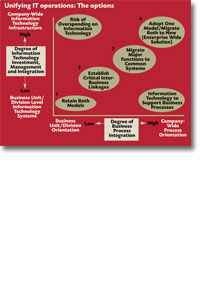
The plans should consist of three phases, says Beveridge. “In the short to medium term, co-existence will be necessary,” he explains, “with both companies having to operate independently.” Any attempts at full-blown integration won't pay off for months or years, so trying to do everything immediately will simply result in absolutely separate systems, and thus companies, in the short term, he says.
Accenture's Chang argues that during this period, the task of the IT department will be to “expedite integration and ensure stability”, two seemingly incompatible tasks. “Successfully expediting integration is largely a matter of recognising that 'good enough' is good enough.” Perfection isn't necessary because the challenge will be to cope with the sheer volume of integration or systems replacement work involved. Any discretionary work must be put to one side so that staff can concentrate on the highest priorities listed in the plan. And all that might be achievable in the short term is the building of gateways and interfaces between systems, rather than any standardisation or total integration.
In the third phase, systems can be integrated more fully, but the degree of unification is up to the companies concerned. Burfitt advocates integrating global systems such as the companies' intranets and enterprise resource planning (ERP) systems, but for local applications, no integration is necessary. It is also worth standardising on a common desktop across the enterprise.
While Josty can think of several situations in which integration beyond the basics is unnecessary and the two companies can continue running more or less separately, he has also seen companies decide that their existing software is not up to the challenges of the integration and that they need something completely new. “But that's a lot rarer.” One exception, Burfitt took the opportunity following the AstraZeneca merger to standardise on a corporate-wide ERP system from SAP.
Helen Donelly Toth, vice president of marketing at Managed Objects, a software vendor that specialises in integrating management information systems, says that “invariably, there will be Holy Wars over which tool is the best to use”.
It is a mistake, of course, to think that one merger is where it will stop. One of Managed Objects' customers, Bank of America, is in a constant flurry of merger activity with other banks, so it has to maintain an open framework to absorb acquired companies' IT infrastructures.
But by standardising on Internet Protocol-based software and browser-based interfaces, says Beveridge, companies are largely 'future-proofed'. “You might have an entirely different structure 10 years down the line, but a browser-based desktop will make it easier to pull everything together.”
Two years on from the AstraZeneca merger and with the bulk of the work done, the company is still going through changes - but not all of them are directly caused by the requirements of the merger. “You needn't look on a merger as a one-off event,” advises Burfitt. “You can look at it as opening up a whole new set of opportunities that become part of a continuing process of expansion.”
Page 1 | Page 2 | Page 3 | All 3 Pages