
MacFormat investigates… Apple TV
- Article 81 of 89
- MacFormat, January 2010
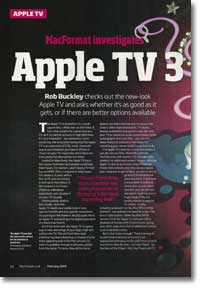
Rob Buckley takes a look at the new-look Apple TV and asks whether it’s as good as it gets or if there are better options available
Page 1 | Page 2 | Page 3 | All 3 Pages
The Apple TV is beautiful. It’s a small square box, a little over an inch thick. It has a few sockets for connecting to a TV, and can deliver pictures in high definition. It’s very minimalist.
Too minimalist for many people.
The accusation: the Apple TV is an expensive (£219), under-featured way to put whatever you have in iPhoto or iTunes on your TV, when there are more powerful alternatives out there. Looked at objectively, the Apple TV does have a few issues that make most people scratch their heads. You will need a TV that has an HDMI, DVI or component video input to use an Apple TV. For content, it syncs with one Mac or PC and streams content with up to five others. If the content is in iTunes, iPhoto or a Windows iPhoto equivalent, you can play it on your TV using the Apple TV.
Usually.
Unfortunately, that’s a big ‘usually’ since the Apple TV needs your media to be in very specific formats and very specific resolutions. Try syncing an AVI movie or an OGG audio file to an Apple TV and you’ll get the digital equivalent of a blank look from it.
But, it has to be said, the Apple TV is a great way to take advantage of your large, high def, widescreen TV. The old Front Row-style interface has been phased out in favour of a far more appealing look in the free version 3.0, which is available through a software update from the Apple TV menu. Now all the menu options are more intuitive and run across the screen rather than downwards. TV shows, movies and photos look great in high def, and your TV or connected audio system make better audio players than your Mac – you can also show iTunes LP content on the Apple TV, something your stereo would be pushed to do.
The Apple TV’s Internet connection means it can also access Flickr, MobileMe galleries, YouTube and, with version 3.0, Internet radio stations for additional content. Indeed, with the Apple TV able to purchase content from the iTunes Store directly, not only can you bypass your computer to get content, you don’t have to go out to the local rental store any more. If you have a reasonable broadband connection, in just a few minutes, you can sit back and watch anything from a huge range of Blu-Ray-quality movies and TV shows, usually including whatever is on Sky Box Office at the moment, but without the need for a Sky+ HD box or subscription. Unlike Sky Box Office, version 3.0 of the Apple TV software offers playback of movies with iTunes Extras, giving you a DVD-style menu full of additional content, such as deleted scenes.
But is that really enough? There’s no way to record content directly to it. It’s not expandable with plug-ins for additional content sources or video formats, not even Flash, so the likes of the iPlayer, 4oD, Sky Player and ITV Player are strictly off limits. The 160GB hard drive is still a little pokey for the average film buff. There’s no DVD or Blu-Ray drive, no web browser. In short, it’s limited.
So why not just get a Mac mini, pimp that up and use Front Row as the front end? The mini lacks none of these limitations. You can add as many Elgato, Miglia et al video devices to it as you have USB ports. iPlayer et al work fine with a Mac mini. It has a DVD drive that can play as well as record. It has a much bigger hard drive that you can expand with an external hard drive. Output is genuine 1080p. Surely that’s perfect?
Well, it is – almost. If you’re renting or buying content on the Apple TV, it can start playing content when only a few percent of it has been downloaded; with iTunes, you have to wait. This makes the Apple TV far more useful for someone who really wants to watch a movie once they’ve clicked the “Buy” button, rather than wait half an hour or longer until it’s all downloaded.
The mini is also very much more expensive (£499) and designed to be a computer. While you can use a remote control to control it, when you want to change passwords, update software, etc, you’re going to have to use a keyboard and mouse, unless you’re a very patient person indeed. The Apple TV needs only a simple remote control that can click and select.
Of course, you can probably deal with the hassles involved with that. The question is: can everyone else who uses your media centre? What happens if there’s a problem? Can they work through all the menus to set up a TV recording? The Mac mini might be more powerful but will it disempower your TV co-user?
There are other alternatives, too. It’s very possible you already have a set-top box that can double as a media player: a games console. The Wii just got its own iPlayer channel, and there have been efforts to get the Wii to play media streamed from Macs, including the open source Wii Media Center X (http://www.redkawa.com/mediacenters/wiimediacenterx/) and the superior Wii Transfer (£12, http://www.riverfold.com/software/wiitransfer/). However, since videos have to be in FLV format and music in MP3 format (Wii Transfer will do the conversions for you, but Wii Media Center X won’t), this is quite limited. The Wii’s maximum output resolution is 480p, too, so this is more of a nice-to-have than a real threat to the Apple TV or anything else.
The Playstation 3 has a built in Blu-Ray player and web browser with Flash 9, so can play some streamed web video, including the iPlayer but not 4oD. It also includes the Universal Plug and Play AV standard (UPnP AV). This allows media streaming from any UPnP AV server on your network, provided it’s in a format that the PlayStation can understand. The Mac doesn’t support UPnP AV, but with the addition of either MediaLink (£12, http://www.nullriver.com/products/medialink) or EyeConnect (£30, http://tinyurl.com/MFEyeConnect), you’ll be able to sync or stream your content to the PS3.
MediaLink is better for the PS3 specifically and it offers iLife integration: photos in your iPhoto library show up in the PS3’s photo menu, and iTunes music appears in the PS3’s music menu. For videos, you can designate any Mac folders as being accessible on the PS3.
The PlayStation is an appealing media centre, but it’s expensive and isn’t as fully featured as the Apple TV or even a Mac mini. Although it finally has a very good video store, which includes 2,000 movies to rent or buy, there are no TV shows and you can’t play anything you’ve bought from the Apple Store on it. If you have a PlayStation already, of course, then the addition of MediaLink is a whole lot cheaper than buying an Apple TV and is probably ‘good enough’. But unless you’re into games and want to get a Blu-Ray player as well, the PS3 isn’t worth buying specifically as a media centre.
The XBox 360 is surprisingly the poorest of the consoles as a media centre. It has an online store (http://social.zune.net/movies) that streams 1080p movies, but there’s not much in it. Out of the box, it doesn’t work with a Mac, but with Connect360 (£12, http://www.nullriver.com/products/connect360), you can stream and sync the majority of your music, photos and videos. But unlike the Wii and the PS3, there’s no web browser so the iPlayer et al are off limits. It’s not the best option and it is very expensive.
The Apple TV also has set-top box competitors, of course, and unsurprisingly, they’re the ones with the best features. However, they almost always have a fatal flaw. Although it’s ugly, Netgear’s Digital Entertainer Elite (£242, http://tinyurl.com/MFDigitalElite) is probably the pick of the bunch. It has almost all the same features as the Apple TV. It works with Macs. It has USB ports for connecting sources of media. It has all the TV outputs you could want, including SCART and HDMI. It works with more video and audio formats, including protected Windows Media and iTunes files and DVD disk images. It can access online stores. It upscales videos and images to 1080p. It has a 500GB drive that you can upgrade.
On paper, it’s almost perfect, but some of the features advertised, such as playback of protected iTunes files, require a PC – iTunes for Mac doesn’t cut it. It’s also got a horrible, unintuitive interface and is far from easy to configure unless you’re very technically able.
The Apple TV, like the Mac, is designed for everyone to be able to use, easily, and works equally well with Windows and Macs. The new Apple TV 3.0 software is far easier to use than Front Row or any of the other combinations and integrates content from linked computers far more simply. The ability to rent and buy from the iTunes store directly from the Apple TV is the main draw, as is its ability to play content you already have in iTunes and iPhoto.
If a powerful media centre is what you want, the Apple TV isn’t it. But if you want a very good media centre that everyone can use and matches the Apple aesthetic, the Apple TV is the one for you.
Box out: Hacking the Apple TV
The limitations of the Apple TV means that ever since it was first released, people have been trying to hack it to expand its capabilities. Since it is literally a closed box, this wasn’t easy.
Nevertheless, the hackers succeeded and have found ways to boost the Apple TV’s capabilities. The Apple TV has a USB slot, but it has no official purpose, except as a way for technicians to run diagnostics. However, it is possible to install software onto a USB flash drive, insert this ‘patch stick’ into the slot and then install new programs on the Apple TV.
There are two main sources of software for hacking the Apple TV: the atvusb-creator page (http://code.google.com/p/atvusb-creator/) and aTV Flash (http://www.atvflash.com/). The former is free and will let you create a patch stick that installs ssh utilities for accessing the Apple TV via UNIX on your Mac; it’ll also add XBMC and Boxee, two media centres that let your Apple TV serve additional Internet content including iPlayer. With SSH enabled, you’ll then be able to do more advanced things, such as attach an external drive to the Apple TV using the USB slot. AwkwardTV (http://wiki.awkwardtv.org/wiki/Main_Page) gives instructions on how to do all of this once your Apple TV has been patched, but you will need to be comfortable with UNIX.
ATV Flash costs £30 but is a user-friendly front end to all of this. Although it doesn’t do absolutely everything possible, it does install additional video codecs and an FTP server so you can copy content directly to the Apple TV. On top of that, it adds NitoTV, a Safari-based web browser, a plug-in manager, an RSS feed reader, a media organizer, a file browser, and support for Jaman Movies. No UNIX knowledge is required, since it’s all done through a simple application.
Page 1 | Page 2 | Page 3 | All 3 Pages