
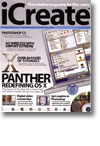
Panther: Redefining OS X
- Article 1 of 53
- iCreate, October 2003
Apple is shortly going to release another landmark version of the Mac OS – Mac OS X 10.3, codenamed Panther. Join us for a guided tour of the future of the Mac platform as we preview the myriad of new features in this major update
Page 1 | Page 2 | Page 3 | All 3 Pages
Every day, in every way, the Mac is getting better and better. You’d like it to be true, but of course, it isn’t. Because what seemed high tech, modern and state-of-the-art not so long ago (“What? I can copy files and move items to the Trash at the same time? This OS 8 is a miracle!”) becomes tired, insufficient and antiquated almost from the moment it’s released as computers will insist of getting faster and cheaper.
Unlike a television or a toaster, though, computers don’t need to be replaced just because they’re a few years old and don’t have the same go-faster stripes as the newest versions. The software that makes a Mac a Mac instead of a Windows PC – a user-friendly instead of user-frightening interface, a marked tendency not to go wrong every time the family pet walks past, and the ability to do quite clever things without demanding its user spend a day in the local library or write to Jack Schofield at The Guardian to find out how to configure it – isn’t soldered into the computer. It’s changeable, upgradeable and every year, it does get better and better.
Provided you’re willing to fork out a hundred quid or so for a few CD ROMs.
Within the next few months, the latest version of the Mac’s personality, its operating system, is going to become available – Mac OS X 10.3 aka ‘Panther’ - and iCreate has got hold of one of the latest test versions to give it a spin and see what new things will make you damn glad you bought a Mac. However, this software is not yet ready for public consumption, otherwise Apple would have started selling it by now, so some things don’t work the way they should yet. Despite all that, 10.3 is already shaping up as a worthwhile upgrade.
For a long time, in the great Mac vs PC, “my computer’s better than your computer” debate that begun in 1984 when Apple released the first Macintosh, Mac users could justifiably claim their computers were better than PCs. Windows was hard to use and crashed more often than Nigel Mansell. That’s not to say Macs didn’t crash. They did. A lot. Windows simply crashed even more often.
But after Microsoft released Windows 95, it became harder and harder to rub PC users’ faces in the dirt. Windows wasn’t that much harder to use and it didn’t crash that much more often. In fact, sometimes it crashed less. And as Microsoft slowly improved their operating systems with Windows 98 (Windows 95 with a web browser) and Windows ME (Windows 98 with a new name), they were developing a new version of Windows – Windows NT, which became Windows 2000 – that didn’t crash very much at all.
Apple knew that sooner or later Windows would overtake the Mac. The Mac’s operating system would need to be improved. Unfortunately, the first Mac’s memory had been so small, the writers of its operating system had had to compromise a lot when writing it. So when Apple decided to modernise its system software, it discovered that its racing car was really a good-looking chassis built round a Ford Anglia.
In a series of cock-ups and disasters of which the Keystone Cops would have been proud, Apple attempted time and again to develop a modern version of the Mac OS as the company eventually called its operating system. ‘Pink’, ‘Taligent’, ‘Copland’ and ‘Gershwin’ all had their development day and all failed. It wasn’t until the arrival of Gil Amelio as Apple CEO in 1996 that the company decided enough was enough and it was time to get radical.
While starting from scratch was appealing, to develop a completely new operating system takes a lot of time and a lot of money, both of which Microsoft had already invested. To ensure Apple wasn’t left a decade behind Microsoft technologically, Apple needed to get a leg up and begin with something that was at least more than a few ideas on a whiteboard.
Things could have gone really badly wrong at this point. Amelio seriously considered waving a white flag of surrender and licensing Windows NT from Microsoft, bolting the Mac’s interface on top of it. Fortunately, someone withdrew his supply of crazy pills and he thought better of it. Soon, a call by one of Apple’s engineers to an old friend at NeXT resulted in something that caught everyone by surprise: the return of Steve Jobs.
Page 1 | Page 2 | Page 3 | All 3 Pages