
In any sentence, it’s always worth considering what is being modified by what. Here, I think we can all agree, it would have been better at the very least to recast that headline as: “How to talk with your children about sex”.

Freelance editor and proofreader
In any sentence, it’s always worth considering what is being modified by what. Here, I think we can all agree, it would have been better at the very least to recast that headline as: “How to talk with your children about sex”.

When I started blogging, all the way back in 2005, I made a slight technological false start and started using Mac OS X Server’s built-in blogging system. That’s what I had, so I thought it a good thing to test.
It wasn’t good.
Plus running my blog off my home computer probably wasn’t the best idea anyway, given 2005’s broadband bandwidth and speed.
I quickly decided to move to a hosted service and to use Movable Type instead. At the time, that was a much better choice, since Movable Type had many technological advantages over its competitors, including its plug-ins, security, minimal use of server resources and built-in caching. WordPress? No thanks.
Twelve years later and my choice wasn’t looking so smart. Movable Type had fallen behind, switched between open and closed source a couple of times, and was now largely focused on the Japanese corporate market. Meanwhile, WordPress had become the de facto standard for blogging. It was time to switch.
Migrating my wife’s company’s web site took about an afternoon, it was that easy. Migrating my 10,000-post media blog was far more of an endeavour, requiring custom coding, rewriting of both Movable Type and WordPress import/export plug-ins to deal with custom field types, and considerable performance fine-tuning. I reckon it took about a month, maybe two, to get everything purring along nicely.
This blog and my own web site, however, took a little longer. That’s mainly because I didn’t have the time to do it, rather than because of any intrinsic complexities. However, I finally began the project in earnest a couple of weeks ago and yesterday, I was at last able to deploy the initial release of the new-look site.
It’s still a slight work in progress and I’ve not yet migrated over my entire portfolio of articles from the previous system. Nevertheless, I think it’s pretty much there and looks a lot more modern than the previous version; it’s also far more suitable for mobile browsing than the Movable Type theme, which was created before responsive sites had even been conceived.
Fingers crossed, it’ll also spur me into blogging a bit more often, as I realise it’s now been about three years since I last posted something here!

Here’s a list of next year’s GeoConnexion International issues, with their corresponding themes and deadlines. If you’re interested in submitting an article, email me so we can discuss topic and angle. You don’t have to write an article that matches more than one theme!
Continue reading “GeoConnexion International’s themes and deadlines for 2019”

GeoConnexion International’s September issue profiled Elaine Ball’s series of educational posters, designed to get kids into survey:
Elaine’s now working on the latest in the series and guess who should be making an appearance. Why, it’s none other than our very own Micki Knight, reading a copy of GeoConnexion International with her pup!

Thanks, Elaine!

Crete is clearly an island with a lot of history – millennia, in fact. Indeed, it has so much history that it doesn’t know what to do with some of it. The likes of Knossos are obviously going to be popular with millions of tourists:
But smaller, less famous, out of the way sites are a slightly trickier proposition. Sometimes, there may not even be room for a car park, let alone the staff to look after the site.
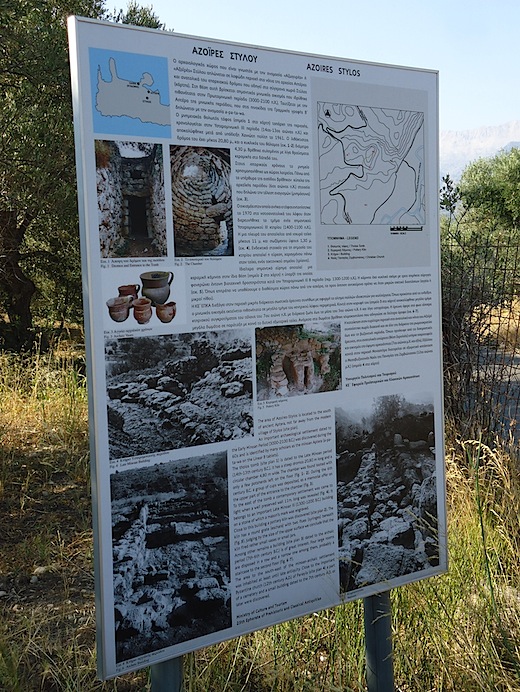
Take the Minoan settlement near the village of Στύλος (Stylos) in NW Crete. It’s a bit up a hill from the village itself and a bit of trek.
You’ll be able to find it easily if you’re walking though, because there’s a sign. Next to a ‘stock fence’.

All you have to do is undo the string securing the fence, peel it back, go through, re-secure the fence, then up the hill you go to the left, through the flock of sheep, turn right and keep going up until you come to a single building with a green roof.

Now you know you’re in the right place. Because there are no signs, no guidebooks, no nothing to tell you where you are. Which is a shame, because there is actually quite a lot further on up the hill, behind the green-roofed building.


Of course, you’re better off reading this web page to find out exactly what.
Things get a little weirder up the hill from the settlement, because there’s actually a Minoan tholos tomb nearby. How do we get there? Well, a little further up the road from Stylos, there’s a grove of trees, behind a proper fence. Look here’s the gate. It’s been padlocked shut. Fortunately, there’s a key attached to it.

Behind the gate is all the information you’re going to get about the tomb and its excavations. Maps? Not really…
So after a bit of wandering around the trees, avoiding (if possible) the cicadas that hurl themselves at you, you might find this:

Could this be what you’re looking for? Why yes, it’s the δρόμος (dromos or path/route) to the tomb. You knew that, didn’t you?
If you’re plucky enough to pick your way down through the grass and the weeds, this is what you’ll find – a Minoan arched entrance to a tholos tomb:

You can just go in. No one will stop you. What’s inside? A coned roof with a hole at the top.

You are now standing in something that people made 3,500 years ago. And you will be literally the only people there and may be the only people who will have been there in days or even weeks.
There’s stuff like this all over Crete. Just look and you should find something like this pretty much anywhere. It’s well worth it.
This was a minor write up and analysis of the Homeric Hymn to Demeter that I wrote for a book club, recently.
It was an event in October to celebrate modern Greek culture and writing. We were there mainly for Bettany Hughes and Victoria Hislop, but both Katerina Vrana and Greece’s answer to Robert Downey Jr, poet/performer Vassilis Amanatidis, proved to be surprise discoveries of Greece is the Word.
And you can watch the whole day’s events below. You probably won’t spot us, though.
A charity to get the classics taught more in schools.
Just a quick note to say that as of the February 2013 issue, I’m going to be editing Geo:International. It’s something of a homecoming for me, since I was editor of Mapping Awareness for over a year, back in the 90s, and it feels good to be back. More details about commissions et al once I’ve settled into the job.
I’m back from learning to be a hacker in Helsinki, which was actually very interesting, particularly with regards to advanced evasion techniques. Thanks to Stonesoft and Harvard for organising it all.
As with most press trips, I didn’t get to see much of the host city, but I did get to see a little on the first day. No snow, but Christmas has definitely arrived, as have the Moomins.


